Thursday, May 31, 2012

Tapestry of Grace Part Six: Organizing Tapestry and Notebooks

Hi, my name is Heather, and I'm a compulsive organizer.

"Hi, Heather. . . . "

Not really.  I do have a thing about checking off boxes, though.  But I digress.

Finally back on track, and wanting to finish my Tapestry series that I started . . . . um. . . . a long time ago. . . . . . . I thought I'd tackle the organization topic.  Because, you know, I'm so organized that I have tons of free time to blog and stuff.  Heh.  Anywho.

First, and MOST IMPORTANTLY!!!!!  If you somehow you get the idea that my life is wonderful, beautiful, perfect and organized . . . .  I have some pictures of my bathroom floors I can post for you.  SO there.  (Go back and read this post if you need a refresher course on the dangers of comparison.)

Now that's out of the way.  Where was I?

Here is one approach - my approach - to organizing my Tapestry year.  (Remember, I am a DE TOG user, so that impacts how I organize to some extent.)  I confess, I enjoy purchasing the SAP packs from Lampstand Press - these are the Student Activity sheets already printed for me, so I only have to print reading lists and overview pages.  Beautiful!  I haven't splurged on color yet, but would love to if the old budget allows.  Once I have my SAP packs in hand, I file Units 2-4, by week, in a large file box:


At this point, I don't separate them out by student yet.  That comes when they go into this file drawer:
To start the school year, I put the first unit into my file drawer in the school room.  Each of my kids has a color, and I put their pages in their own folder for the week-plan.  If I'm a good Mommy, I sit down and get all the reading assignments and overview pages printed for the unit - these are not included in the SAP  packs.  (Usually, however, I'm not so on top of it by the 2nd or 3rd Unit - and I'm printing away the night before or - gasp! - the day of our set-up meeting!)

You might notice in the file I also have a file for Evaluations - these are the quizzes and unit exams for my Dialectic and Rhetoric students.  

When it's time for our set-up meeting, I bring our handy-dandy colored folders to the table and - ta dah! - the pages are where they are supposed to be.

Now, a quick word about notebooks:

Some of you have noticed that I don't use 3-ring binders.  Instead I use a system that I originally purchased from Levenger - the Circa notebook system.  Happily, this year I noticed our local Staples carrying a similar system - oh, the joys!!

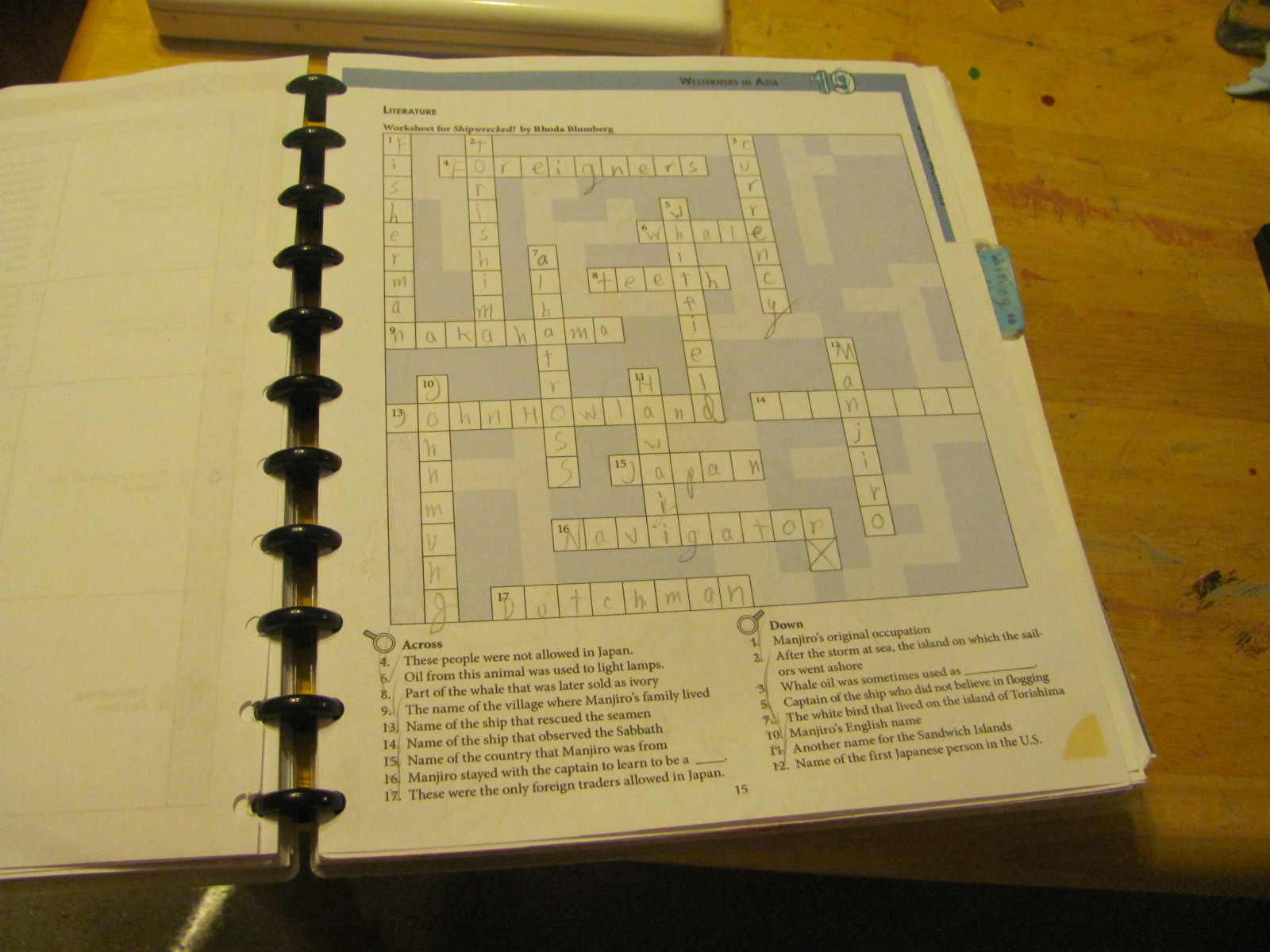
I love these notebooks because the bindings lay flat, I can rearrange pages at will, and my kids can even punch random notecards, drawings, etc and put them in with their regular size papers.  Here's an up close look at one:

My daughter's Upper Grammar notebook
Opened to show the General Information page.  Note the advanced academic note-taking at the bottom. :p
A map page.  This year, though, the kids made a section in the book just for maps.

Example of an Upper Grammar Literature response page.

And this year I apparently got my act together with vocabulary.  Yay, me!
So there you have it!  A look at our notebook system.

As always, feel free to send me questions or your own ideas through the comment section.  I'd love to help!  Next up:  Writing Aids!


Friday, March 30, 2012

Tapestry of Grace, Part Five: Your Questions Answered!


By popular demand. . . . . . or not-so-popular demand, but a few people asked, and we're going on the "contact your congressman theory".  You know, the one that says, "If x number of people bother to contact you about an issue, then 75x people actually feel the same way about that issue."

It's a word problem.   And what do homeschoolers do with word problems?

We make our children solve them.  We're sneaky that way.

Anywho.

This post was about TOG, not math.

Because I'm pulling my hair out about my choice of math for next year, so I'm not going to blog about it.  I have that whole "Perfect Homeschooler" image to keep up, after all.

Alrighty then.  Here are a few questions I've gathered this week, with my answers.

 Do you buy books or use the library?
This reminds me of a gag my husband likes to pull on kids, "Do you walk to school or take your lunch?"  The answer?  Both.  Here's my philosophy:

Since I have a "large" family, I buy almost all of the Rhetoric books, usually from Bookshelf Central.  I figure it's a good investment; they will be used by 3 other children, Lord willing.  After that, I buy all of the Dialectic literature books, and any Dialectic history book that's used for 3 weeks or more.  For the Grammar books, and a large bunch of Dialectic books as well, I use our library - we are blessed with a great library that has a county-wide system of lending.

I have a decent library to begin with, being a former Sonlight user and all, and try to pull in those books as much as possible.  I'm not very good at it, though.  *sheepish grin*

Are you a paper or DE user?
DE now.  Started with paper.  I didn't think I'd like it - but - I LOVE IT!!!  Especially now that I'm - ahem - advanced in my age.  I love being able to magnify my teacher's notes during discussions!

I don't actually print up much, and I thought I would.  But keep in mind, I'm not a big highlighter, so you might want to print up the notes and mark 'em up for discussion. Other than that, DE rocks!

When do your kids start Dialectic level work?
Usually after reminders, prodding, poking, and hot cocoa. . . . .

Oh, wait, wrong answer.

It depends on the kid.  For some, 5th, for others, 6th.  This year I put my 5th grader on D level  - and it was probably too early.  But honestly, I didn't feel like she was being challenged enough on the UG level, and it was easier for me to put her with her older sister and have a little modeling of higher-level work.  It's been kinda painful, but I think overall good.  A good rule of thumb is once they approach puberty, and start the very fun stage of arguing, debating, and asking why to everything - they're ready for dialectic work.

How do you determine which level your children should be on each year?
Ah, this goes along with the previous question.  Actually, I let age/grade be my guide.  My kids are academically either on par or above grade level (and I'm not bragging - or I hope I'm not! - it's just what the Lord has given to us).  So I use this as my guide:  K-2 Lower Grammar, 3-5 Upper Grammar, 6-8 Dialectic, 9-12 Rhetoric.  Except this year I didn't.  Hm.  Maybe explains why I've been so frustrated with one of the Dialectic Duo.  I should probably start reading my own blog posts.


What do you use for writing?
Yes, I am a rare bird that uses Writing Aids.  I'll be blogging about that soon, I hope.  I have this strange, negative reaction to a lot of writing programs - kind of like nails on a chalkboard.  Writing Aids doesn't make me want to pull my hair out or cringe over formulaic instruction.  It's not for everyone, though - not by a long shot.  More details to come!

What's your favorite lapbook source?
I love the kits from Lampstand Press!  They are sanity savers, especially the ones that are already printed and in a kit for you!

How do you handle weeks when other children get behind due to other commitments?
Awesome question!!!  We actually had that happen last year - my son went on a major Boy Scout trip right in the middle of the spring semester.  The nerve!  I just arranged for him to double up and catch up on his own schedule, so for a few weeks we were NOT all on the same topic.  Oh, well.  We survived. 

Sometimes at the end of the semester, I'm caught with too many week-plans and not enough time to finish.  I have been known to double up in May, and just breeze through the end of the material.  For most levels, the last week of the Year Plan is a little lighter, so it's not too hard to do.

Why is discussion so important?  Can't they just write the answers to the questions?

Ok, well, they can.  But.  Why are you homeschooling your kids?  It's not just to pull a Rumplestiltskin on them - you know, "Go take these books into your room and spin them into an education!"

The heart of homeschooling is the heart of your kid.  TOG gives you the opportunity to hear their heart, and to pour into their lives.  By discussing, you can communicate your excitement about the topic, lead them to conclusions, help them synthesize information, and wrestle with important ideas together.

Still not sure you can handle it?  Lampstand Press sells an amazing DVD called "Leading Socratic Discussions" that not only explains the process, but shows you moms having discussions with their students - both one-on-one and in a group.  (And as a side bonus, it has some great applications to parenting, not just your school work!)

*********
Hope that helps!  Truthfully, I'm getting a cold, and my brain's a little fuzzy :)  I'm happy to answer more questions or clarify - just pop a note in the comment box!  Or if you have a better answer than mine (which you probably do!) put that in the comments as well.  I might even ask you to be a guest blogger if my cold gets worse. . . . .

Next up - probably after Easter - how I organize Tapestry.


Monday, March 26, 2012

Tapestry of Grace Part Four: Grammar Students

These days, you just say the word, "Grammar Student" and I start grinning.  This is why. . . . . . .


The last of the bunch.  The tagalong.  4th daughter in a family of 5 children.  The family mascot.  Our unique, wonderful, funny, interesting. . . . . 

Oh.  Wait.  Y'all were wanting me to talk about TOG.  Sorry. . . . 

But what I just wrote actually IS pertinent.  See, right now, my grammar girl's position in the family has everything to do with her experience in Tapestry.  When you do a week-plan with a grammar student who is the last in a large family, it will look different than a week-plan with a grammar student who is your oldest.  And that's ok!  Remember - don't compare your family to mine.  I just want to offer you a glimpse into what a grammar student's week can look like.  As they say, "Your Mileage Might Vary".

Let's take this in two parts, shall we?

Part One -  What I "Used" to do with Grammar Students, and What I "Wish" I had time to do Right Now:

Day One:  Have a set-up meeting to look at the goals and books for the week.
Day Two:  Start Reading - together - History books.  Go over vocabulary words, and make a note of what words the student has never heard.  Assign vocabulary words for handwriting practice.  (I never have had them write out definitions.  Probably my bad.)
Day Three:  Continue reading history books, mostly the "Core" selections.  Day Three is usually Map Day, so we'll mark maps and talk about what has happened so far in history - informally, not using the Socratic method ;)  
Day Three is also the day I'd choose to read the Literature selection to a younger, Lower Grammar student who is not reading confidently.  (Although, it could be any day of the week, as it usually takes only one reading session)
Day Four:  Finish reading History books; add in an In-Depth selection if desired.  Start hands-on project if it will be an involved project.
Day Five:  Hands-on day!  Choose one or two projects, complete during History time.  Students also complete their Literature "Activity Page" (affectionately known as their "SAP") this day.  
A shot of a Lower Grammar SAP.  Focus:  summarizing information in her stories.


Part Two -  This Year's Reality:

Day One:  Have a set-up meeting to look at topic & books for the week.  Darling Grammar Girl picks out a hands-on activity from the list on the Student Pages, then sighs, "But we probably won't get to it, right Mom?"
Day Two:  Read History books together.  Snuggled.  On my favorite chair.  Under a blanket. 
Day Three:  Read more history books together.  Snuggled.  On my favorite chair.  Under a blanket.  Usually, we'll work on her Lapbook together, completing 1 or 2 books.
Day Four:  Supposed to be hands-on day.  But - like she said - we usually don't get to it.  I really want to improve this next year!!!
Day Five:  This is discussion day for her older siblings.  We try to finish our week's lapbooks.  She usually wanders in to our discussions (it's the hot cocoa, I swear!) and makes some utterly funny, insightful, and cute comment.  Love that.

So.  There you have it.  A not-so-glamorous look at my Grammar week!  But before I go, let me just leave you with two things:

Lapbooks.  I love 'em.  I used to love creating them, designing them - but now, I love even more the Lapbook Kits!!!  Here's a shot of one of them in action:


 She had a lapbook about MLK Jr.'s "I Have a Dream" speech.  She was supposed to copy the phrases and glue them down, but I actually scrambled them for her and had her rearrange them in the correct order.  Worked better for us that way.

I'll have to add a picture of the finished product, but we really do enjoy these.  They're nice for showing grandparents, too!  (I should probably explain these more, but my post is already getting long!)

Tapestry Teacher Training Videos.  You know on Facebook, how you have those times when you wish there was a "Super Like" button?  That's how I feel about these videos.  I mean, they're amazing.  Encouraging, informative. . . . you really, REALLY need to watch these.  And look!  Yay, me - I figured out how to embed a couple!!!!

Tapestry of Grace | Grammar Level Overview from Tapestry of Grace on Vimeo.


 You think that one is good?  Listen to me people. Watch this next one.  Right. Now.  Then get your friends, and make them watch it.  Best. Homeschooling. Encouragement. Ever.

You won't regret it.  I promise.

Tapestry of Grace | Spiritual Encouragment for Homeschooling from Tapestry of Grace on Vimeo.


I just listened to it again.  It's that good.  Don't you think???

Thanks for listening.  Next in the series:  How I Organize Tapestry.  Sick of me yet??? :)


Sunday, March 25, 2012

Sunday Sentiments: Washing Machine Theology


You know, there's nothing that strikes terror into the heart of the mom of 5 like a puddle under the floor of the washing machine.

Visions of unwashed laundry mountains flashed before my eyes. . . . I was convinced  (convinced I tell you!) that our washing machine had breathed its last.  Fighting back waves of panic, I started surfing the local big box retailers' websites, pricing new machines.  The choices were overwhelming; top-loader, front-loader, energy star compliant, high-efficiency, eco-friendly.  Which one was right for our family?  How in the world was I ever to choose?

Thankfully, I didn't have to make that decision - the puddle was a result of a faulty plumbing issue.   But I was reminded of this moment because of a comment a friend of mine made at dinner the other night.  "You once told me," she quipped, "that mothers are like washing machines. . . you have to know your capacity!"


The idea was not original to me, although I'd love to claim that moment of brilliance as my own.  But it's one I've shared over and over again with many a friend and mother - truthfully, usually a homeschooling mother - when the beast named Comparison rears its ugly head.

You know the one.  You've seen her, heard about her, read her blog, or heard her speak at a homeschooling convention. She's the mother who seems to Have It All Together.  She rises while it's still dark, runs 4 miles, has incredible devotions, and then teaches her 9 kids from lesson plans she made up herself while grinding her own wheat for bread and keeping her house spotlessly clean.  Her children are obedient, creative, and beautiful.  Her husband adores her, has a successful job, and brings her flowers "just because".  She's crafty, she's kind, she runs a home-based business, she ministers to orphans. . . . . . you name it, she does it.  And does it well.

And you sink in your shoes, ashamed and inadequate, measuring yourself by a yardstick that will do nothing but throw your own woeful shortcomings back in your face. 

But then . . .then you hear a voice. . . . . . the voice of Jesus. . . . .

"If it is My will that he remain until I come, what is that to you?
You follow Me!"  (John 21:22)

Jesus was speaking to Peter; good old Peter, the one I can relate to, who just blurts out whatever he's thinking.  He's comparing himself to "the disciple that Jesus loved" (John), and asking what John's future will hold.  Apparently, the Comparison Beast is not new, nor even claimed exclusively by homeschooling mothers! (I don't think Peter even owned a denim jumper. . . . a little homeschool mom humor there for ya!)

But what was Jesus saying, and what can we take away, store in our heart for our times of need?  In my mind, I imagine something like this:

"Peter.  Have you not learned?  Have you not learned to keep your eyes on Me?  Not on the waves, not on the sword, not on other disciples, but on Me?"

And is that not what Jesus is calling us to as well?  Dear sisters in Christ, is that not our challenge?

Keep our eyes on Jesus.  Not on our circumstances, not on our curriculum, not on our husband or our children or our careers or our homemaking. . . . . .

But on Jesus.

Know your capacity.  Know what God has called you to.  And stay true to that calling.

To go back to the washing machine analogy.  Some of us are standard washers. Others can handle a king-sized comforter with room to spare.  Still others are apartment-sized compact machines. 

Know your capacity.  Know what God has called you to.  And stay true to that calling.  Not anyone else's. . . . . yours.

And it's okay, dear ones.  It's okay that you can't do it all, and do it all perfectly.  Jesus loves you.  He died for you.  Your worth does not rest in who you are, but in Whose you are.  

Keep your eyes on Jesus.  His grace is sufficient.  His love is endless.  And He - He alone - is worthy.


Friday, March 23, 2012

Tapestry of Grace Part Three: Dialectic Delights!

Ah, the middle school years.  Gotta love 'em!  We're starting our fourth middle schooler this year, and I have to say for energy, drama, and exuberance you can't beat this stage.  And God has blessed us with FOUR count 'em, FOUR girls. . . . you moms know I don't need to say any more :)

Anywho.  This was about Tapestry.

Here is my Dynamic Dialectic Duo, in all their Discussion glory:


(Note the ever-present mugs of hot cocoa.  I think that's what my kids will remember about homeschooling.  Hot cocoa.  And we live in ALABAMA, people!)

In theory, my dialectic girls work in the same way as my rhetoric son.  Answer questions all week, read on your own, be prepared for discussion Monday afternoon.

Note the crucial words:  "In Theory"

Here's how it plays out in my house right now:

On Tuesday, we have our set-up meeting in the afternoon.  On Tuesday morning, while I'm teaching at a local co-op, my 7th grader takes the Accountability and Thinking questions and types them into a word processing document.  She then prints two copies for her and her sister to use as worksheets to answer questions.  (Mommy Trick:  I used to print these up for the kids.  Then I asked them to take over that responsibility.  Delegation, my friends, is a beautiful thing.)  During the set-up meeting, we go over what books they are to read, and I try to walk through the questions with them.

Here would be a good place to explain the difference between Accountability and Thinking questions; this is a question I'm asked fairly frequently!

• The Accountability questions are those that my girls in theory be able to answer on their own.  (Again, note the crucial words:  "in theory")  These are generally factually-based questions; "Who was the president? What were the most important battles in the war?  Who did it impact?"  I require that they write answers to those accountability questions.

•The Thinking questions are more difficult, and require more inference and drawing conclusions; "What was the relationship between x and y? Why did president x think this was a good idea?  What would you have thought of this event, if you lived then?"  I typically don't require written-out answers, but encourage the girls to jot phrases or ideas down on their pages.

On Monday after lunch, we sit down for our discussion time; my Tapestry "week" runs Tuesday through Monday, which I explained in an earlier post.   My dialectic discussion takes around 45 minutes to an hour, depending on our topics.  The girls are eager, interested, and prepared for a meaningful, educational, interesting look at our topics of the week. . . .

All Together Now. . . . "In Theory"!!!

The theory is that it works smoothly and seamlessly.  The reality is that - well - my younger student struggles with being prepared.  The theory is easier for me and plays into my idol of the stress-free life; the reality is that God has given me these opportunities to teach, train, and encourage my daughter - and to - ahem - work on my own sanctification in the process!

 It's so easy to forget the learning curve - when you look at your motivated and responsible 7th grader, reading, answering, staying on track - and remember that she once struggled, had to be guided, encouraged, loved, and helped along the road.  So I pray for a calm spirit, for love, for patience, and for wisdom. . . . . . . . and here is what has helped.

At the beginning of the year (August-September), I definitely expected too much from her.   After 2 or 3 weeks of being unprepared for discussions, I realized I needed to sit down with her, and help her break down her readings for the week.   For a month or so, we talked through her questions,

"So, these questions have to do with Civil Rights.  Which book do you think might have the most information?  What day would you like to read that book?"

"Here are questions about President Kennedy.  Where would we find that?  How many pages do you have to read on Wednesday to cover that book?"

And so on.  Helping her think about how to find the information, rather than feeding it to her.

And to be honest, she's still not there.  About 3 weeks ago, she AGAIN came unprepared.  I dismissed her older sister, and she & I sat at the table for an hour, as I gave her a "supervised study hall" while she looked for work.  It was tough, but we perservered.  Her consequence was that we had her discussion the next afternoon, during a time she had regularly scheduled a "playdate" with a friend.

She's getting better.  And so am I!  At realizing that this homeschooling journey is not entirely about education, but it's about the relationships we have with each other, and how we lean on Jesus.  The middle school years are a crucial time to connect, in so many ways - and Tapestry helps me to do just that.

Thanks for listening and reading, everyone!  Hope this gives you a little glimmer of how I approach TOG with my Dialectic age students.  Next up - Grammar Stage!  And remember, please leave a comment if you have a question you'd like answered. . . .I'm saving a few of them, and will hit questions in another post.